
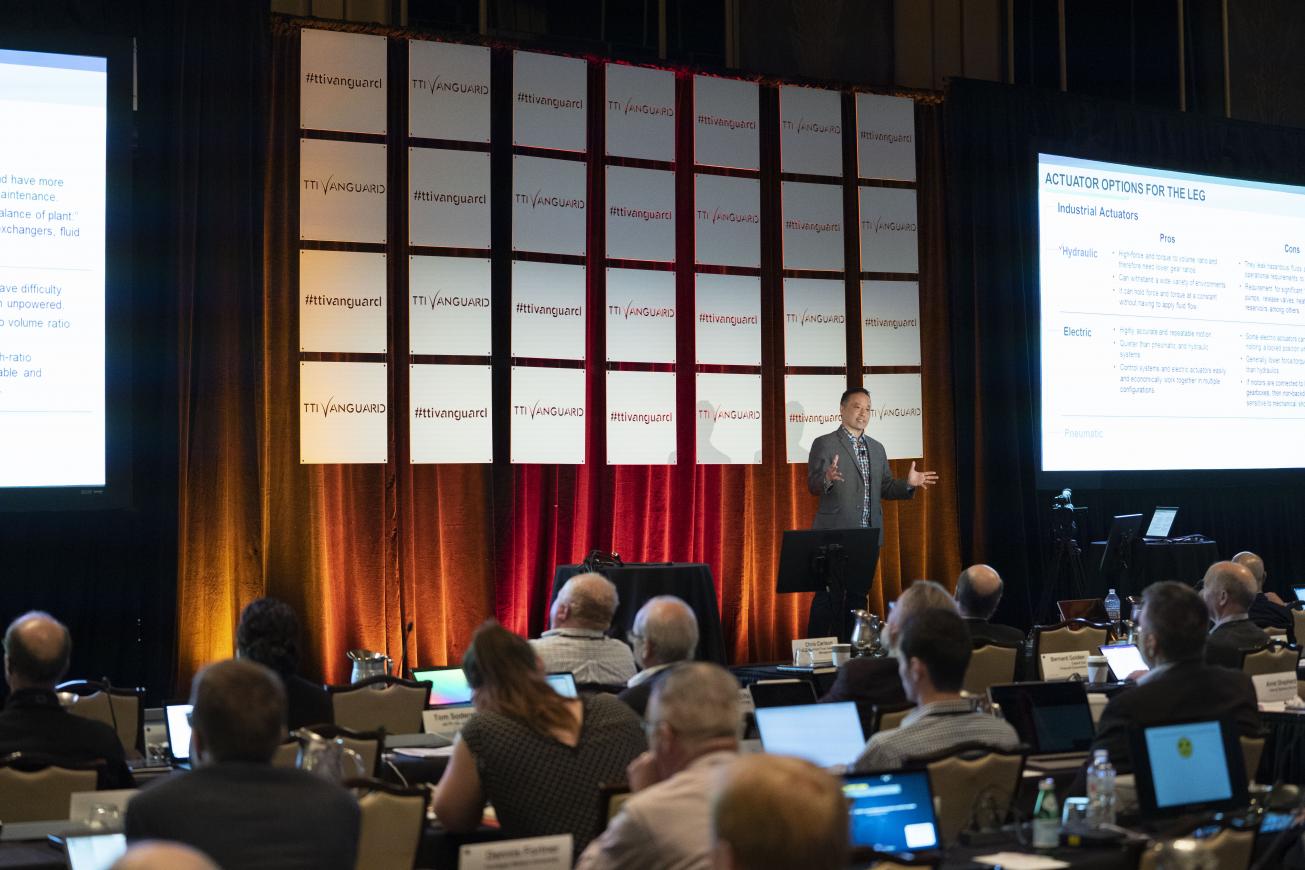
TTI/Vanguard is an advanced technology membership for senior-level executives. We introduce, discuss, and evaluate emerging and breakthrough technologies on the two-to-five-year horizon. Through research, conferences, workshops, and field trips, experts offer perspectives on future technologies and their impact on organizations, infrastructures, policies, and society. The result is a framework for linking strategic technology planning to business success. TTI/Vanguard is a wholly owned subsidiary of Institutional Investor, an international business-to-business information company.
TTI/Vanguard's member organizations represent global private, public, and academic sectors.
This diversity brings an unequaled richness of perspective and experience to TTI/Vanguard’s forums.
*Please note this list is a partial list*
Accenture
Air Force
American Express
BNSF Railway
BP
CAE Inc.
Comcast Corporation
Enterra Solutions, LLC
Federal Reserve Board of Governors
FedEx Corporation
Fidelity
Infineon Technologies
Institute for Defense Analyses
Intel
Internal Revenue Service
Johns Hopkins University
Kroger
MedStar Health
MIT Lincoln Laboratory
MITRE Corporation
National Institute of Informatics
Navy Federal Credit Union
NEC Corporation
OneMain Financial
Pacific Northwest National Laboratory
T-Systems Multimedia Solutions
University of Maryland
USAA
W. W. Grainger Inc.
Additional videos available to TTI/Vanguard members. Please login to access the archives.
Click the Member Login button on the top right corner.
To create a new password, please select Forgotten Your Password.
If you have any trouble accessing your account, please reach out to Brooke Lowenhar at brooke.lowenhar@iiforums.com.



Organizations join TTI/Vanguard for early warnings about breakthrough and potentially disruptive technologies; a challenging vision of the future; and the power of our network. TTI/Vanguard membership is based on an annual subscription fee.
For detailed information, call:
Lew Knox
Executive Director
(212) 224-3826
lknox@iimemberships.com
Hotel Information
Questions about hotel reservations and conference logistics.
TTI/Vanguard
1270 Avenue of the Americas, 11th Floor
New York, NY 10036
Tel: +1 (212) 224-3300

Lewis Knox
Executive Director
lknox@iimemberships.com

Kelly Baughman
VP, Business Development
kelly.baughman@ttivanguard.com

Brooke Lowenhar
Director of Client Services
brooke.lowenhar@iiforums.com

Nancy Kleinrock
Senior Writer
nk33@cornell.edu

Tony Shaw
Moderator
tshaw@ttivanguard.com